How Does Negative Self-Talk Impact Your Golf Game?
Negative self-talk can destroy your round in the blink of an eye. And research shows that excessive negative self-talk can result in noticeable decreases in accuracy, decision-making, and recovery time. Here's exactly how negative self-talk sabotages your round and what you can do about it!

Why Golfers Struggle with the Mental Game of Golf
Golfers of all ages and all skill levels will tell you 90% of the game is mental, yet most golfers spend less than 10% of their practice time working on mental skills. Unlike physical skills that you can see and measure, negative self-talk operates subtly in the background, gradually eroding confidence and performance over time.
The mental game becomes even more critical as skill level increases. Tour professionals often cite mental toughness and process-focused skills as the key differentiators between good players and great players.
The Science Behind It: How Your Mind Hijacks Your Swing
Research shows that being hard on yourself during a round creates measurable changes in your body and mind:
Drains Mental Energy - When you get lost in negative thoughts, your brain uses its energy to manage those thoughts instead of focusing on course management, club selection, and reading greens. This means you're less locked-in during crucial shots.
Triggers Stress Response - Negative thoughts can flood your body with cortisol and create muscle tension that kills the smooth, fluid swing you practice on the range. Your grip tightens, your shoulders tense up, and tempo goes out the window.
Creates Mental Burnout - Golfers who engage in frequent self-criticism show higher rates of burnout and lose the joy that keeps them improving. A weakened mental state makes every challenge on the course feel bigger than it actually is.
The result: Instead of playing "one shot at a time," you're fighting yourself on every swing.

What Negative Self-Talk Sounds Like on the Course
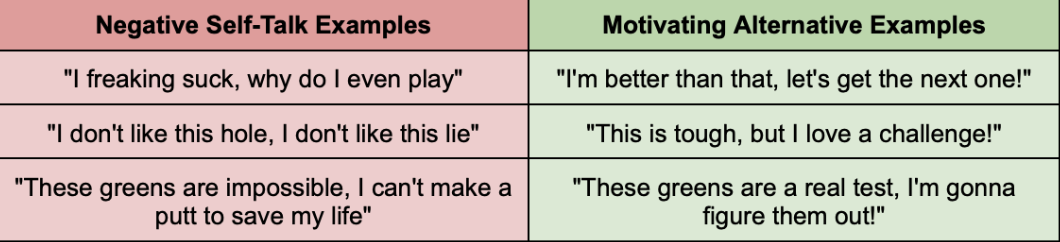
How Negative Self-Talk Impacts Your Golf Game
Swing Performance - Swinging a golf club requires intense precision, making it particularly susceptible to the physical tension that often accompanies negative self-talk. When your grip tightens and your shoulders tense up, the smooth pendulum motion of swinging becomes much more difficult.
Course Management Decisions - Self-criticism impairs decision-making abilities. Golfers experiencing negative self-talk may be more likely to take unnecessary risks, choose the wrong clubs, and make poor strategic choices that lead to higher scores.
Recovery from Bad Shots - Elite performance in golf largely comes down to bounce-back ability. Based on voice analysis data from InnerLoop, golfers who take over 60 seconds to mentally reset after negative self-talk typically have lower-performing mental games overall.

The Fix - 3 Immediate Strategies
Build Your Go-To Vocabulary: Instead of trying to avoid negative self-talk, focus on creating instructional and motivating phrases to use instead. Write down three specific phrases you can use when facing challenges on the course.
Examples: "Smooth and steady," "Trust the process," or "Next shot mindset." Practice these phrases on the range first, then use them in competitive rounds.
The 10-Second Reset Rule: Give yourself 10-20 seconds after a bad shot to feel frustrated, but once that time is up, shift to neutral or positive self-talk. This allows you to feel the emotion without letting it control your next shot.
Master Your Breathing Between Shots Learning to take smooth, steady breaths during negative emotions is crucial for resetting your nervous system. Practice focused breathing at home using a breath timer like Xhalr.com. Just 3-5 minutes daily can dramatically improve your on-course composure.
Track Your Progress and See Results
Golfers who train their self-talk can see real improvements in just weeks, but you need to measure your progress and train the right things!
Start tracking these three details:
How long does it take you to bounce back after a bad shot?
Which situations trigger your worst self-talk? (putting, pressure shots, bad lies)
What phrases do you find yourself saying most often?
Your self-talk isn't just mental “chatter”; it's a skill you can improve with practice.
Use InnerLoop AI to learn to talk to yourself like a champion and measure your self-talk in every round.
Common Questions About Golf Self-Talk
How long does it take to change negative self-talk patterns?
Most golfers can see measurable improvements in 2-3 weeks with consistent practice. The key is daily repetition of replacing negative phrases with intentional motivating alternatives.
Is it normal to have negative thoughts during a round?
Absolutely. Even Tour professionals experience negative thoughts. The difference is that they have trained systems to quickly shift back to productive, neutral, or positive self-talk!
What's the difference between being realistic and being negative?
Realistic thinking acknowledges challenges without emotional judgment ("This is a tough pin position, I need to aim for the center of the green"). Negative self-talk includes emotional criticism ("I always mess up these shots, I hate these shots").
Can positive self-talk really improve my scores?
Yes, research shows that golfers who improve their self-talk patterns can see a change in their mental game within a month. These improvements can lead to better decision-making, reduced tension, and faster recovery from mistakes.
How do I remember to use positive self-talk during pressure moments?
Practice your go-to phrases during low-pressure practice sessions first. Create physical triggers (like adjusting your glove) that remind you to use your prepared phrases during pressure situations.
Ready to take control of your mental game? Use the InnerLoop app to begin tracking your self-talk with real data and receive research-backed strategies to improve it. Your future rounds will thank you.

Master Your Mental Game, Master Your Scores
Negative self-talk in golf isn't just a mental distraction; it's a measurable performance killer that affects your swing mechanics, decision-making, and recovery time. But here's the good news: your self-talk is completely within your control.
By implementing the three strategies above - building your phrase vocabulary, using the 10-second reset rule, and mastering your breathing - you can transform your mental game in just weeks. Remember, every Tour professional has dealt with negative self-talk. What separates them is their ability to quickly shift back to productive thoughts.
Start with one strategy today. Track your patterns. Measure your progress. Your mental game is a skill just like your swing - and with practice, it will become your greatest competitive advantage on the course.
Start using InnerLoop today by clicking here.
