How Long Should It Take Me to Bounce Back After a Bad Hole?
Honestly, you’re asking the wrong question. The question isn't 'how fast should I bounce back?', it's 'am I bouncing back effectively?' Some golfers try to move on too quickly without processing what happened, while others get stuck replaying mistakes for multiple holes. Here's how to find the right balance and develop a recovery process that actually gets you back to playing great golf!

Why Recovery Time Matters for Your Golf Performance
Your ability to mentally recover directly impacts your performance. Putt lipped out, bad bounce, plugged in the bunker, the variety of adversity is endless. But, when you don't properly process that adversity and reset after a bad hole, several things happen that hurt your game:
Emotional Carry-Over - Unresolved frustration from one hole bleeds into your decision-making on the next. You might play too aggressively to "make up" for the bad hole, or too conservatively because you're afraid of another mistake.
Physical Tension - Suppressed emotions can create muscle tension that affects your swing tempo and rhythm. Your grip tightens, your shoulders tense up, and the smooth swing you practice on the range disappears.
Focus Fragmentation - Part of your mental energy stays stuck on the previous hole instead of being fully present for the current shot. This divided attention often leads to silly mistakes and execution errors.
Confidence Erosion - Without proper processing, one bad hole can make you question shots you normally execute confidently. This doubt creates hesitation and tentative swings that compound the problem.
The good news? Creating and implementing an effective recovery process, regardless of how long it takes, prevents these negative consequences and keeps your round on track.
Why Recovery Time Varies Between Golfers
Every golfer processes setbacks differently. Some need time to analyze what went wrong, while others perform better when they quickly shift focus to the next challenge. Some golfers more naturally process adversity; others have to build the skill intentionally. There are a million variables that affect how golfers bounce back. The key is developing a consistent recovery process that matches your personality and playing style.
What doesn't work is having no process at all, either rushing past emotions without learning, or getting trapped in negative thought cycles that affect multiple holes.
The Science Behind Resilience in Golf
Research shows that your ability to bounce back after a bad hole depends on three key psychological factors that you can actually develop and strengthen:
Self-Belief - Athletes who believe in their ability to handle tough situations recover faster from setbacks. This isn't about overconfidence; it's about trusting that you have the skills to work through challenges. Golfers with stronger self-belief are more likely to view bad holes as temporary obstacles rather than proof they "can't play."
How You Think About Problems - The way you process what went wrong makes a huge difference. Research shows that golfers who focus on solving the problem ("I need to commit to my club selection") bounce back more effectively than those who just try to manage their emotions ("I need to stop feeling frustrated"). This problem-focused thinking helps you learn something useful from the mistake.
Your Support Network - Having people who understand your game - whether that's playing partners, coaches, or family- significantly improves your ability to recover from tough holes and tough rounds. Athletes with strong social support systems show higher resilience and bounce back more quickly from setbacks.
The key insight: Resilience isn't something you're born with - it's a set of skills you can practice and improve. The most resilient golfers actively work on building their self-confidence, developing problem-solving thinking patterns, and surrounding themselves with supportive people.
What Effective vs. Ineffective Recovery Looks Like
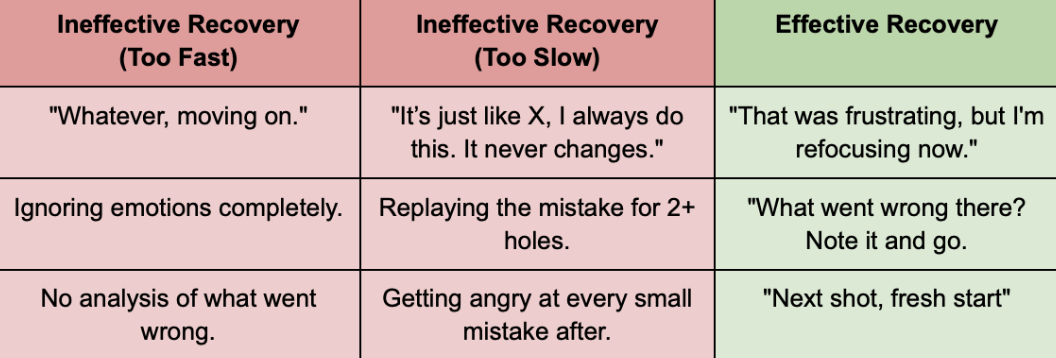
Signs You're Taking Too Long to Bounce Back
You're still thinking about a bad hole when you reach the tee box 2-3 holes later.
Your playing partners notice your mood has changed for multiple holes.
You find yourself rushing shots because you're behind the pace of play.
Small mistakes later in the round trigger bigger emotional reactions.
You feel like one bad hole "ruined" your entire round.
Signs You're Moving On Too Quickly
You make the same mistake repeatedly without adjusting.
You feel frustrated but can't identify why.
Emotions build up and explode later in the round over small mistakes!
You miss obvious course management lessons from bad holes.
You feel disconnected from your round or "going through the motions".

The 3-Step Recovery Process That Works
Give Yourself Permission - As you walk off the green or to your next shot, permit yourself to feel frustrated. Use this time to acknowledge what happened without trying to fix it immediately. Simple phrases like "That was tough" or "I'm frustrated and that's okay" help you process rather than suppress.
The Learning Moment - Before reaching the next tee, quickly identify one specific thing you can learn. Not self-criticism, but useful information: "I was between clubs," "I rushed that putt," or "I let the previous hole affect my focus." Keep it factual, not emotional.
The Fresh Start Ritual - Develop a consistent physical action that signals "new hole, fresh start." This could be adjusting your glove, taking three deep breaths, or saying a specific phrase like "This hole, this shot." Make it the same every time so your brain recognizes the reset signal.
Track Your Recovery Patterns
Start noticing your own recovery patterns by tracking these elements:
Situation: What type of mistake triggered the need for recovery?
Duration: How long did it take you to fully refocus?
Method: What self-talk helped you reset and refocus?
Effectiveness: Did the recovery method help your performance on subsequent holes?
The goal isn't to get faster - it's to get more consistent and effective with your recovery process
The InnerLoop app is an excellent tool to track these patterns! Metrics like bounce back time, most common phrases, and Self-talk-score correlation all let you know if your recovery process is working!
Common Questions About Resilience in Golf
Is it better to bounce back quickly or take time to process?
Neither speed nor slowness is inherently better. The key is having an intentional process that includes acknowledgment, brief analysis, and deliberate reset. Some situations require 30 seconds, others need several minutes.
How do I know if I'm dwelling too long on mistakes?
If you're still actively thinking about a previous hole when you reach the next tee box, or if your mood affects multiple holes, you're likely dwelling too long. The goal is to learn and move forward, not to relive the mistake.
Should I try to forget bad holes completely?
No, completely suppressing or ignoring mistakes often makes emotions resurface stronger later. Brief acknowledgment and learning is healthier than pretending nothing happened.
Do professional golfers have bad holes that affect them?
Absolutely. Tour players have the same emotional reactions, but they typically have more developed recovery processes from years of practice and often work with mental performance coaches to refine these skills.
What if my playing partners want to talk about my bad hole?
You can politely redirect: "I'm working on moving forward quickly; let's focus on this next hole." Most playing partners will respect your mental game approach once they understand it.
How long should recovery take during practice rounds vs. tournament rounds?
Practice rounds are perfect for experimenting with different recovery timeframes and methods. Tournament rounds are not the time to experiment, but rather to implement what you’ve already practiced and stick to it. In tournaments, you may find the challenge of resetting to be greater than in practice! This makes sense as the stakes are often higher in tournaments, and that creates more powerful adversity!

Find Your Optimal Recovery Rhythm
Mental recovery after bad holes isn't about speed; it's about effectiveness. Your optimal bounce-back time might be 10 seconds or 2 minutes, and both can work perfectly if you have an intentional process.
The key is developing a consistent approach: acknowledge your emotions, briefly learn from what happened, and deliberately reset for the next challenge. With practice, this process becomes automatic and helps you maintain mental toughness throughout your entire round.
Start paying attention to your natural recovery patterns and refine them based on what actually helps your performance. Your mental game is a skill just like your swing - and with the right recovery process, you'll turn bad holes into learning opportunities instead of round-ruining disasters.
Ready to develop a more effective mental recovery process? Use the InnerLoop app to track your bounce-back patterns and receive personalized strategies based on your actual recovery data.
Your future rounds will thank you.
